Co-Signing a Loan in Canada: What It Does to Your Own Mortgage
Someone you care about has asked you to co-sign a loan. Before you sign, it helps to know what the debt does to your own credit, your own mortgage and your own bank account if things go wrong.
- Rules checked November 24, 2026
- By Krish Paul
- 9 min read
On this page
This guide shows what you take on, works out in dollars how a co-signed payment can shrink the mortgage you qualify for, and lists the questions to ask the lender first.
The short answer
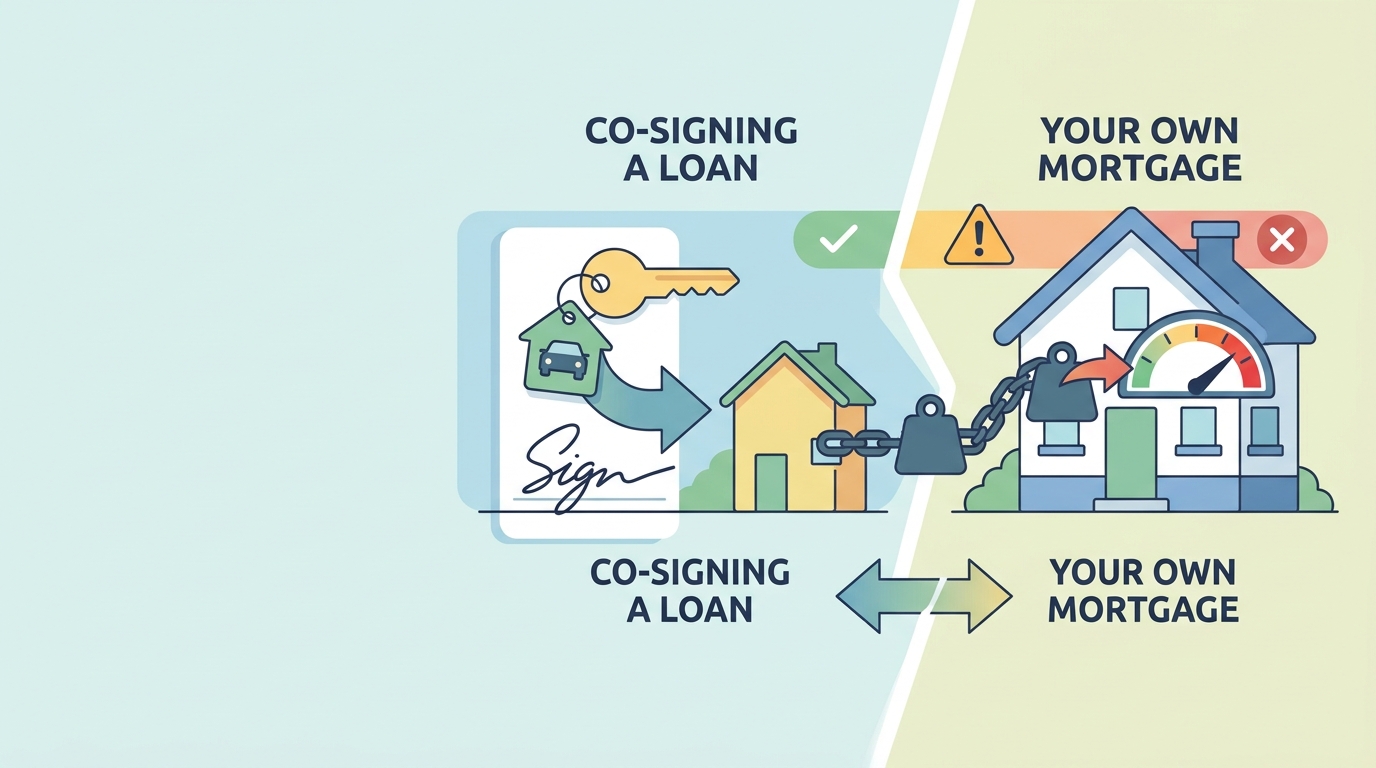
Co-sign only if you could make every payment yourself for the whole term and you do not need to borrow while the debt is open. A co-signer is equally responsible for the unpaid balance, the borrower’s late payments can hurt your credit, and the payment can count as your debt when you apply for a mortgage.
How much that last part costs you depends on the debts you already carry. In our two examples below, the same $506.91 car payment cut one person’s mortgage approval by $19,693 and the other’s by $75,678. If you plan to buy or refinance a home in the next few years, run your own numbers first.
How much could co-signing cut your mortgage approval?
Enter your gross yearly income, the monthly debt payments you already have and the payment on the loan you are asked to co-sign. The result updates as you type.
Uses the lower of the 39% housing limit and the 44% total debt limit, minus $450 a month for property tax and heat, at a 6.5% qualifying rate over 25 years. Real lenders also check your credit, down payment and other costs. Calculator by Gizly.

What am I actually agreeing to?
The Financial Consumer Agency of Canada (FCAC) defines a joint borrower as someone who signs a mortgage, loan, credit card or line of credit agreement with one or more other people. It says this is also called co-signing, and that joint borrowers are “equally responsible for repaying the unpaid balance.”
So you are not a character reference. You are a borrower on the debt, even if you never touch the money.
The Financial and Consumer Services Commission of New Brunswick (FCNB) adds what that means in practice. If the borrower does not pay, you may face collections or legal action. If the loan paid for a car or furniture, the lender can repossess and sell it, and if the sale does not cover the balance, you and the borrower still owe the rest, which may include repossession costs, interest, penalties and fees.
Some lenders ask for a guarantor instead of a co-signer. On a credit card, the FCAC says a guarantor is responsible for the balance but has no access to the account. Being added as an additional cardholder is different again: you are not responsible for the money owing. Ask the lender which role you are signing for.
Will it hurt my credit score?
It can. FCNB says the borrower’s late payments or default “will be reflected in your credit report,” which can lower your score and affect your future credit. FCNB also notes that you usually cannot control how the money is spent.
The flip side: if every payment is made on time, nothing bad shows up. The risk is entirely about what happens if the borrower’s life changes, through a job loss, an illness or a breakup.
How co-signing shrinks your own mortgage
This is the part most people miss. When you apply for a mortgage, lenders work out two ratios. The FCAC explains that your housing costs should not be more than 39% of your gross household income (the gross debt service, or GDS, ratio), and your housing costs plus all other debts should not be more than 44% (the total debt service, or TDS, ratio).
Housing costs mean the mortgage payment, property tax, heat and half of any condo fees. Your payment is tested at a qualifying rate, the higher of 5.25% or your contract rate plus 2 percentage points. CMHC uses the same 39% and 44% limits for insured mortgages. FCNB says co-signed debt can raise your debt-to-income ratio and make it harder to qualify for your own credit.
Why the same payment hurts some people far more
The gap between the two limits is 5% of your monthly income. If you have no other debts, the 39% housing limit is what holds you back, and up to that 5% gap of other debt costs you nothing. Only the part of the co-signed payment above the gap reduces your mortgage.
If you already have a car loan or card payments, that gap is used up, and every dollar of the co-signed payment comes straight off what you can spend on a mortgage. At a 6.5% qualifying rate over 25 years, each $100 a month of extra debt removes about $14,929 of mortgage.
Two people, one car loan
Both examples are hypothetical. The loan is $25,000 for a car at 8% a year over 60 months, so the payment is $506.91. We assume a 6.5% qualifying rate (a 4.5% contract rate plus 2), a 25-year amortization and $450 a month for property tax and heat.
- Priya earns $90,000 and has no other debts. Her 5% gap is $375 a month, so only $131.91 of the car payment counts against her. Her approval drops from $369,500 to $349,807, a cut of $19,693.
- Marc earns $120,000 and already pays $900 a month on other debts. His gap is gone, so the full $506.91 counts. His approval drops from $455,344 to $379,666, a cut of $75,678.
Credit cards count too. For insured mortgages, CMHC tells lenders to count a card or unsecured line of credit at a payment of at least 3% of the balance. A co-signed card carrying $5,000 would add $150 a month to your debts, even if the borrower always pays.
What happens if they stop paying?
The amount at stake is whatever is left on the loan when the payments stop, plus costs. On our $25,000 car loan, that is $20,764 after 12 months, $18,516 after 18 months and $11,208 after 36 months. Over the full term the borrower pays $30,415, of which $5,415 is interest.
If the car is repossessed and sold, the sale price comes off what is owed. FCNB says that if the sale does not cover the balance, you and the borrower still owe the rest, plus costs.
What people get wrong about co-signing
- “I only pay if they default.” The FCAC says joint borrowers are equally responsible for the unpaid balance. You owe the debt alongside the borrower, not as a backup.
- “I can take my name off later.” FCNB says the borrower usually needs to qualify to refinance alone or pay off the loan to release you.
- “If they pay on time, it does not affect me.” On-time payments protect your credit, but the debt can still count against you when you apply for a mortgage, as Priya and Marc found.
- “I will know if something goes wrong.” Only if you watch the account. Ask for your own statements from day one.
Can I see what is happening on the account?
Yes, at a bank or other federally regulated lender. The FCAC says every joint borrower has the right to information on the interest and other costs, and to the same ongoing statements the other borrowers receive. You can give that right up only by consenting, and a verbal consent must be confirmed in writing. Credit unions regulated by a province may follow different rules, so ask.
The one test before you sign
Treat the loan as if it were yours alone. For our example, that means being ready to cover $506.91 a month for five years.
- Check your budgetCould you pay the full payment without missing your own bills?
- Check your plansAre you likely to apply for a mortgage, refinance or a car loan while this debt is open?
- Check the exitIs there a date by which the borrower will refinance alone?
What to do next
- Ask the lender which role you are signing for. Co-borrower and guarantor carry different access and terms. Read the whole agreement before you sign.
- Run the calculator with your own numbers. If you might buy or refinance soon, ask a mortgage lender how they would count the co-signed payment.
- Ask these questions in writing. Will I get my own statements? Will this account appear on my credit report? Who will you contact first if a payment is missed? What would it take to release me?
- Set up monitoring. Get online access to the account and check your Equifax and TransUnion reports a few times a year.
- If you have a problem with a bank, make a complaint and keep notes. A bank must give you a detailed written answer within 56 calendar days. If you are not satisfied, you can take it to the Ombudsman for Banking Services and Investments (OBSI), which is free.
The FCAC does not settle individual complaints, but it can explain a bank’s complaint process. If co-signing is not right for you, you can still help with a smaller gift you can afford, or by helping the person build their own credit first.
Thinking about the loan itself? Our guides on leasing versus buying a car and debt consolidation loans show the full cost of borrowing.
Frequently asked questions
If I co-sign and they stop paying, do I have to pay?
Yes. The FCAC says people who sign a loan, credit card or line of credit together are equally responsible for repaying the unpaid balance. The lender can ask you for the money, send the debt to collections or take legal action, and any shortfall after a repossession can also fall on you.
Does a co-signed loan show on my credit report?
It can affect your credit. The New Brunswick regulator FCNB says the borrower’s late payments or default will be reflected in your credit report and can lower your score. Check your own Equifax and TransUnion reports after you sign.
Will co-signing affect my mortgage approval?
It can. Lenders add your debt payments to your housing costs and compare the total with your gross income. CMHC uses a 44% limit for insured mortgages. In our hypothetical examples, a $506.91 co-signed car payment cut one buyer’s approval by $19,693 and another’s by $75,678.
Can I take my name off a loan I co-signed?
Usually not on your own. FCNB says the borrower would normally need to qualify to refinance the loan alone or pay it off. Agree on that plan, with a date, before you sign.
Can I see the statements on a loan I co-signed?
At a bank or other federally regulated lender, every joint borrower has the right to the cost disclosure and the same ongoing statements as the other borrowers, unless they agree to give that up. Ask for online access on day one.
What is the difference between a co-signer and a guarantor?
A co-signer, or co-borrower, is equally responsible for the balance and gets the account information. The FCAC describes a guarantor on a credit card as responsible for the balance but without access to the account. The exact terms depend on the contract you sign.
- Sources, checked November 24, 2026: FCAC: Disclosure of information to joint borrowers (modified 2025-10-15); FCAC: Joint credit cards (modified 2025-10-15); FCAC: Preparing to get a mortgage (modified 2025-10-15); FCAC: How to file a complaint with your bank (modified 2026-09-16); CMHC: Calculating GDS / TDS (published 2018-03-31); FCNB: What you should know before co-signing a loan (undated).
- Method: Car loan payment and balances use standard monthly amortization. Mortgage amounts use the lower of the 39% GDS and 44% TDS limits, minus $450 a month for tax and heat, discounted over 300 months at 6.5% compounded semi-annually, as Canadian fixed-rate mortgages are. Results were checked with a closed-form formula and a month-by-month sum. All examples are hypothetical.
Important: This guide is general information, not legal or financial advice. Your loan agreement sets your exact obligations, and lenders can use their own qualifying limits. If you are unsure what you are signing, speak with a lawyer or financial professional first. Gizly is not paid by any lender mentioned here. See our affiliate disclosure.
Send it to a friend, a family member or a coworker with the same question. It takes one tap.
How this page was made: Gizly uses AI tools to help research and draft its guides. Krish Paul, the editor, is responsible for what Gizly publishes. Spot an error? Tell us and we will fix it.
Keep reading



Compare before you switch
Rates and offers checked against each bank’s own page.