Rent or Buy a Water Heater in Ontario? The 2026 Break-Even Math
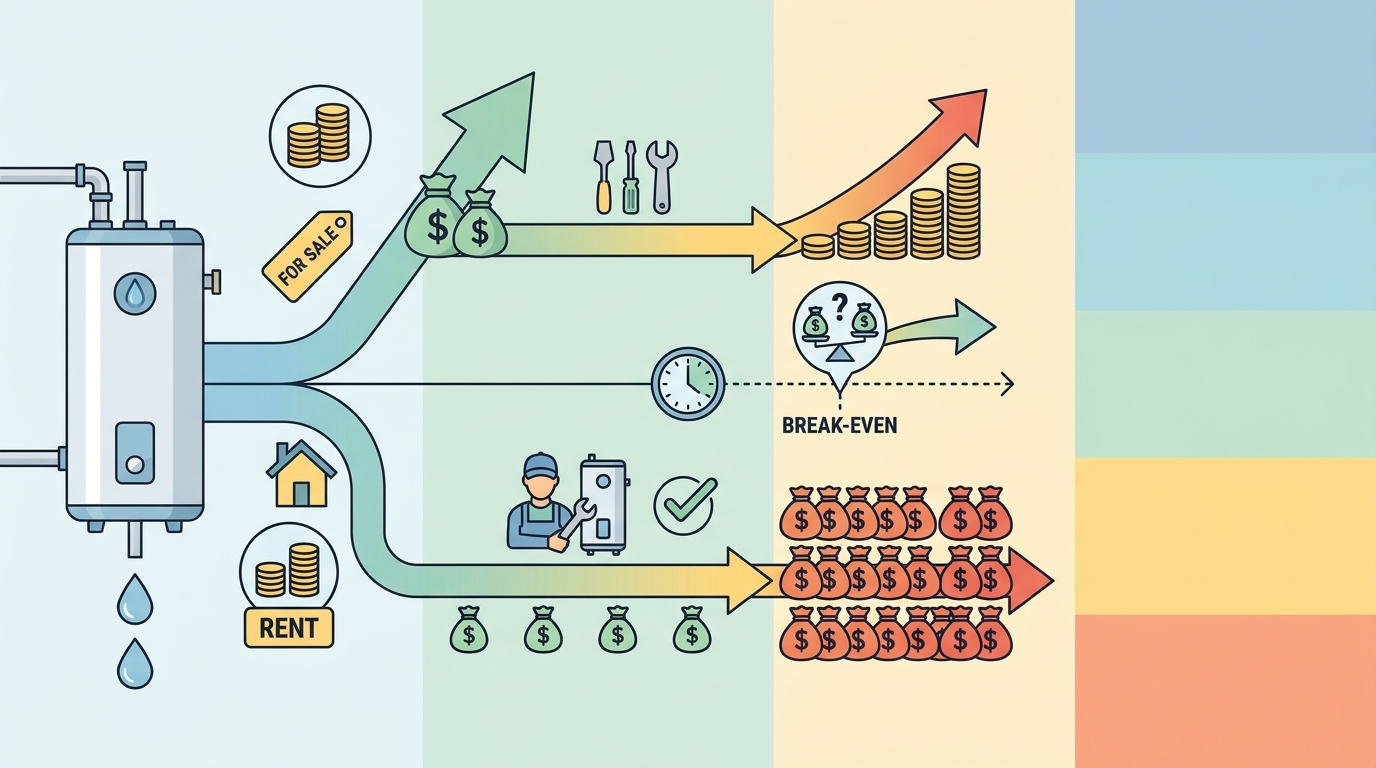
A rented water heater can look cheap at $19 to $47 a month. Using one provider’s own 2026 prices for both options, the rent passes the cost of buying within about five to nine years.
- Prices and rules checked November 22, 2026
- By Krish Paul
- 7 min read
On this page
We compared Enercare’s published purchase and rental prices for six tank types and worked out when the rent passes the price of buying.
The short answer
Buying a water heater is usually cheaper than renting in Ontario if you stay in the home for its full life. On Enercare’s own average prices, the rent you pay passes the installed purchase price after 64 to 111 months, and most tanks last 12 to 15 years. Renting makes more sense if you cannot pay upfront without expensive debt, or you expect to move within a few years.
Enercare’s 2026 buyer’s guide lists an average purchase cost including standard installation and an average monthly rental for each type, all plus HST. Because both figures come from the same company and both exclude HST, the comparison is like for like.
Rent or buy: work out your own numbers
Enter a purchase quote, a rental rate and how long you expect to keep the tank. The result updates as you type.
Rent total = monthly rent x 12 x years, before HST. It leaves out repair costs, rate changes and interest on cash. Calculator by Gizly.
How long until renting costs more
Every type crosses over well before the end of a normal tank life. The bars show the month when total rent first reaches the installed purchase price.
The power vent gas tank crosses over fastest. The electric tank is the closest call because its rent is the lowest, yet it still crosses over more than two years before the low end of a tank’s life.
What each type costs to rent or buy
Here are Enercare’s starting figures, with what 12 years of rent adds up to. Twelve years is the low end of the lifespan Enercare gives for tank models, so the gap is likely larger if your tank lasts longer.
| Type | Buy, installed | Rent a month | Rent, 12 years | Extra cost to rent |
|---|---|---|---|---|
| Electric tank | $2,131 | $19.29 | $2,778 | +$647 |
| Gas, conventional vent | $1,804 | $25.87 | $3,725 | +$1,921 |
| Gas, power vent | $2,430 | $38.01 | $5,473 | +$3,043 |
| Gas, direct vent | $3,730 | $42.43 | $6,110 | +$2,380 |
| Gas, power direct vent | $4,069 | $46.97 | $6,764 | +$2,695 |
| Tankless (natural gas) | $4,135 | $52.17 | $7,512 | +$3,377 |
Enercare figures are Ontario averages and “starting from” prices, before HST. Extra cost to rent = 12 years of rent minus the installed purchase price. Calculated by Gizly.
The gap keeps growing for as long as the tank works, because the purchase is paid once and the rent never stops. Here is how that looks for the power vent tank.
Why the real rent may be higher
Enercare’s rates are starting prices. Reliance Home Comfort’s 2026 Ontario pricing guide shows ranges based on its standard 7 and 10 year terms:
- 40-gallon conventional gas: about $25 to $28 a month.
- 40-gallon power vent gas: about $39 to $44 a month.
- 40-gallon electric: about $20 to $23 a month.
A higher rate makes break-even arrive sooner, so buying looks better, not worse. Neither provider’s page says whether rates rise over time. Read the rate-change clause in any agreement before you sign, because yearly increases would widen the gap further.
What the rent pays for, and what owning costs
The figures above compare the equipment only. Renting does bundle in some things an owner pays for separately.
If you rent
- UpfrontNothing. Installation is included.
- Every monthA rental bill for as long as you keep it.
- RepairsCovered during the expected life, with terms and exceptions.
- If you sellEnercare says the agreement can transfer to the buyer.
If you buy
- UpfrontThe installed price, with a warranty and required licences included.
- Every monthNothing for the tank itself.
- RepairsYours once the warranty ends.
- Either wayThe gas or electricity to heat the water costs the same.
Enercare says rental customers get repair coverage during the anticipated useful life of the equipment, with terms and exceptions. Reliance says it charges nothing for repairs, or for replacement when a unit cannot be repaired, based on normal use. Enercare also says the average Ontario household spends over $580 a year heating water, a cost you pay whichever way you go.
So the real question is repair risk. In the power vent example, renting costs $3,043 more over 12 years. If you would not expect to spend that much on repairs outside the warranty in that time, buying still wins.
Rent or buy: three questions
If the numbers favour buying but you are unsure, these questions cover the main reasons people keep renting.
If repairs are the worry, an emergency fund covers them without a monthly fee. If you finance a purchase instead, check the full cost first. Our guide to no payments, no interest financing shows how.
If you already rent: getting out of the contract
You can usually buy out a rental tank or replace it with one you own, but there may be costs.
- Buyout. Reliance says you can purchase your equipment at any time and the buyout amount depends on the unit’s age. Ask for the figure in writing.
- Ending a contract. The Ontario government says that if you switch suppliers, there may be fees for ending your current contract and having the existing equipment removed.
- Selling your home. Enercare says its rental agreement can be transferred to the buyer. Check the transfer terms before you list the home.
Ontario rules that protect you
Water heaters are a restricted product under Ontario’s door-to-door sales rules. Since March 1, 2018, a business cannot sell or rent you one at your home unless you contacted it first and invited it over. A technician on a repair visit cannot sign you to a new contract.
Day 1
You receive a written copy of the agreement. The 10-day cooling-off period starts.
Within 10 days
Cancel for any reason, with no penalty.
Up to 1 year
You can still cancel if you never got a written contract, or the business made a false or misleading statement about it.
A contract signed in breach of the rules is void, and you can keep the equipment with no obligation. Since May 1, 2018, the supplier rules also require contracts to show the overall cost and any cancellation fees.
Before you rent or buy
Get these answers in writing so you can compare real numbers.
- A purchase quoteInstalled price for the same type and size, plus the warranty length on the tank and parts.
- The rental termsMonthly rate, term length, and whether and how the rate can rise.
- Exit costsBuyout amount by age, removal charges and cancellation fees.
Frequently asked questions
Is it cheaper to rent or buy a water heater in Ontario?
Buying is usually cheaper if you keep the tank for its normal life. On Enercare’s Ontario averages, rent passes the installed purchase price after 64 to 111 months, depending on the type, and most tanks last 12 to 15 years.
How much does it cost to rent a water heater in Ontario?
Enercare lists starting rates from $19.29 a month for an electric tank to $70.01 for a condensing tank, plus HST. Reliance Home Comfort’s 2026 guide shows about $25 to $28 a month for a 40-gallon conventional gas tank and about $39 to $44 for a 40-gallon power vent tank.
How much does it cost to buy a water heater in Ontario?
Enercare’s 2026 buyer’s guide gives average starting prices, including standard installation, of $1,804 for a conventional vent gas tank, $2,131 for an electric tank, $2,430 for a power vent tank and $4,135 for a tankless natural gas unit, plus HST.
Can I buy out my rental water heater?
Usually, yes. Reliance Home Comfort says you can buy your equipment at any time and that the buyout amount is based on the unit’s age. Ask your provider for a written buyout quote, and ask about any removal or cancellation fees.
Can I cancel a water heater rental contract in Ontario?
If you signed at home, you have a 10-day cooling-off period to cancel without reason, starting when you get a written copy of the agreement. After that, ending a contract can involve fees for ending it and for removing the equipment, so check your agreement.
- Sources, checked November 22, 2026: Enercare: 2026 Water Heater Buyer’s Guide (average purchase and rental costs, lifespan, running cost); Enercare: Tank Water Heater Rental in Ontario (rental rates, installation, repairs, transfer); Reliance Home Comfort: 2026 Ontario Water Heater Pricing Guide (rental ranges, repairs, buyout); Government of Ontario: Door-to-door sales and home service contracts; Government of Ontario: Rules for businesses entering into contracts at a consumer’s home.
- Method: Break-even month = purchase price divided by monthly rent, rounded up. Extra rent over 12 years = monthly rent x 144 minus purchase price. All figures before HST, which applies to both options at the same rate. Results were computed by script and checked with a second month-by-month count. We did not include rate increases, repair costs or interest on cash, because the sources do not publish them.
Important: This guide is general information, not financial advice. Prices, rental terms and promotions change and vary by home; get written quotes before you decide. Gizly is not paid by Enercare or Reliance, and this page has no affiliate links. See our affiliate disclosure.
Send it to a friend, a family member or a coworker with the same question. It takes one tap.
How this page was made: Gizly uses AI tools to help research and draft its guides. Krish Paul, the editor, is responsible for what Gizly publishes. Spot an error? Tell us and we will fix it.
Keep reading



Compare before you switch
Rates and offers checked against each bank’s own page.