How Much Cash Can You Bring Across the Canadian Border? The $10,000 Rule
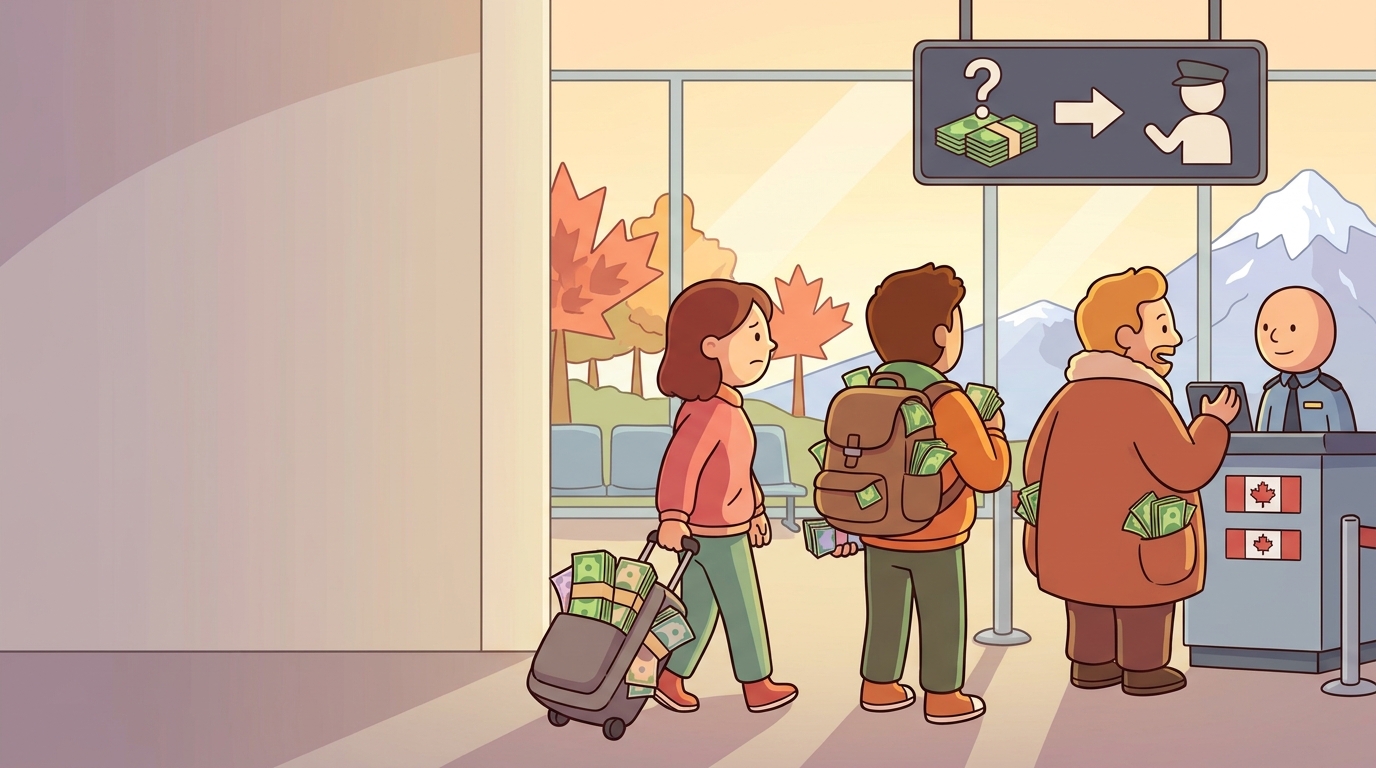
You can carry as much money as you like into or out of Canada. What you cannot do is cross with CAN$10,000 or more and keep quiet about it.
- Rules checked November 16, 2026
- By Krish Paul
- 7 min read
On this page
This guide covers the exact reporting rule, how foreign cash is converted, and what each penalty level costs if the CBSA seizes your money.
The short answer
There is no limit on how much money you can bring into or take out of Canada, but you must report currency and monetary instruments worth CAN$10,000 or more to the Canada Border Services Agency (CBSA), both when you arrive and when you leave. The total counts Canadian and foreign cash together, plus items such as cheques, bank drafts and money orders. If you do not report it, the CBSA can seize all of it and charge a penalty of 5% to 50% to return it.
The rule comes from the Proceeds of Crime (Money Laundering) and Terrorist Financing Act and the Cross-border Currency and Monetary Instruments Reporting Regulations. The CBSA sends every report to FINTRAC, Canada’s financial intelligence agency. Reporting the money does not mean you lose it.
What would a penalty cost you?
Enter the amount that was not reported, in Canadian dollars, and pick the situation. The result updates as you type.
Penalty rates from section 18 of the reporting regulations. An earlier seizure moves you to 25% or 50%. The CBSA decides which level applies, and money it suspects is proceeds of crime is not returned for a penalty. Rounded to the nearest dollar. Calculator by Gizly.
What counts toward the $10,000
The threshold is “$10,000 or more”, so carrying exactly CAN$10,000 has to be reported. Add up everything you have on you and in your bags:
- Cash in any currency. Canadian and foreign bills and coins are combined into one Canadian-dollar total.
- Negotiable instruments that are in bearer form or pass to whoever holds them: bank drafts, cheques, promissory notes, traveller’s cheques and money orders.
- Securities in the same form: stocks, bonds, debentures and treasury bills.
The regulations leave out warehouse receipts, bills of lading, and cheques or other instruments that carry a restrictive endorsement. The CBSA names bank drafts on its list of items to declare, which surprises people who buy one to avoid carrying cash.
How foreign cash is converted
Foreign money is converted at the Bank of Canada exchange rate in effect when you cross. The bank publishes one rate per currency each business day by 4:30 p.m. Eastern. Here is where the line fell on the latest published rates when this guide was checked:
| Currency | Bank of Canada rate (CAD per unit) | Report at or above |
|---|---|---|
| US dollar | 1.4257 | US$7,015 |
| Euro | 1.5734 | €6,356 |
| UK pound | 1.8848 | £5,306 |
| Mexican peso | 0.07686 | MX$130,107 |
| Indian rupee | 0.01513 | ₹660,939 |
Source: Bank of Canada daily exchange rates for November 13, 2026. Each amount is CAN$10,000 divided by the rate, rounded up to the next whole unit. Rates change every business day.
US cash is the one to watch. On November 13, US$7,000 was worth CAN$9,979.90, just under the line. If the US dollar had been worth CAN$1.4286 or more, the same bills would have crossed it. If your total is within a few hundred dollars of the threshold, declare it.
How to declare it, arriving or leaving
- Add up the total. Combine every currency and every instrument at that day’s Bank of Canada rate.
- Fill in the right form. Use form E677 for your own money. If you carry money for someone else, or send it by mail or courier, use form E667.
- Arriving in Canada: declare it at the airport kiosk, on your CBSA Declaration Card, in your Advance Declaration, or by telling the border services officer.
- Leaving by air: go to the CBSA office on the arrivals level before you pass security screening. At a small airport with no CBSA office, visit the nearest CBSA office before your flight.
- Leaving by land, sea or rail: report at a CBSA office before you leave Canada. You cannot use NEXUS when you carry CAN$10,000 or more.
Money sent by mail or courier has to be declared too. For a parcel leaving Canada, the CBSA asks you to give a copy of form E667 to the nearest CBSA office and attach a Canada Post CN23 customs form.
The US border uses a different line
US Customs and Border Protection asks travellers to report more than US$10,000 on FinCEN Form 105. Canada uses CAN$10,000 or more. Because the two lines are in different currencies, a trip south can trigger one report and not the other.
Take a hypothetical family driving from Toronto to Buffalo with US$8,000 in cash on November 13. At the Bank of Canada rate, that is CAN$11,405.60, so they must report it to the CBSA before leaving Canada. On the US side, US$8,000 is not more than US$10,000, so no FinCEN 105 is needed going in. On the way home, the Canadian report applies again if what they carry is still worth CAN$10,000 or more.
What happens if you do not declare
The CBSA can seize all of the currency and monetary instruments when the full value was not reported, not just the part over $10,000. Unless it suspects proceeds of crime, the officer offers terms of release: you pay a penalty and the money is returned. The penalty depends on how the money was carried and on your history:
- 5%, up to $2,500, if you did not hide the money, told the officer everything when it was found, and have no earlier seizure.
- 25% if you hid it (other than in a false compartment), made a false statement about it, or had an earlier seizure for another reason.
- 50% if you hid it in a false compartment in a vehicle, or had an earlier seizure for hiding money or giving a false statement.
On CAN$20,000 of unreported cash, the three levels cost $1,000, $5,000 and $10,000. The money is not returned for a penalty if the officer suspects it is proceeds of crime or terrorist financing. In that case it is seized with no terms of release.
How to challenge a seizure
You have 90 days after the date of the seizure to ask for a decision of the Minister. If you disagree with that decision, you have 90 days after you are notified to appeal to the Federal Court of Canada. If the review finds no contravention, the penalty you paid is refunded. These timelines come from the CBSA’s memorandum D19-14-1.
Before you cross with a large amount
- Count the drafts and chequesThe CBSA lists cheques and bank drafts as monetary instruments, so they go into the same $10,000 total as cash.
- Check the rate that morningThe Bank of Canada rate moves daily, and a total near the line can tip over it.
- Keep your bank receiptsA withdrawal slip is not required, but it makes the source of the money easy to show if an officer asks.
- Think about moving it electronicallyA wire transfer or card payment is not money you carry, so it is not part of the border report.
If you want to avoid carrying cash at all, compare what banks charge for a wire transfer with the cost of using a card abroad, including foreign transaction fees and ATM fees. Depositing a large amount of cash after you get home is a separate rule. Our guide to cash deposits over $10,000 explains what your bank has to report.
Frequently asked questions
How much cash can I bring into Canada?
There is no limit. You can bring in any amount, but you must report currency and monetary instruments worth CAN$10,000 or more to the CBSA when you arrive. The total includes Canadian and foreign cash together, plus items such as cheques, bank drafts, money orders and traveller’s cheques.
Do I have to declare cash when leaving Canada?
Yes. The same CAN$10,000 threshold applies when you leave. If you fly, report at a CBSA office on the arrivals level before you go through security. By land, sea or rail, report at a CBSA office before you leave. You cannot use NEXUS when crossing with CAN$10,000 or more.
Is the $10,000 limit per person or per family?
The rules put the duty on the person carrying the money: currency in your possession or your baggage must be reported. The CBSA pages checked for this guide do not set a rule for adding up a group’s cash, so if your family is close to the line, declaring is the safer choice.
What happens if I forget to declare $10,000?
The CBSA can seize all of the currency, not just the amount over $10,000. To get it back you pay a penalty of 5% to 50%. The lowest level, 5% capped at $2,500, applies if you did not hide the money, told the officer everything when it was found and have no earlier seizure.
Can I get seized money back?
Yes, once you pay the penalty, unless the CBSA suspects the money is proceeds of crime or terrorist financing. You have 90 days after the seizure to ask for a decision of the Minister, and 90 days after that decision to appeal to the Federal Court.
Is the US cash limit the same as Canada’s?
Close, but not the same. US Customs and Border Protection asks you to report more than US$10,000 on FinCEN Form 105. Canada asks for a report at CAN$10,000 or more. So exactly US$10,000 does not need a US report, but it is well over the Canadian line.
- Sources, checked November 16, 2026: CBSA: Travelling with CAN$10,000 or more (modified 2026-05-29); Cross-border Currency and Monetary Instruments Reporting Regulations (SOR/2002-412), current to 2026-10-19, sections 1, 2 and 18; CBSA Memorandum D19-14-1, paragraphs 16 and 33 to 42; Bank of Canada daily exchange rates (rates for November 13, 2026); US CBP: Money and other monetary instruments (modified 2020-03-12).
- Method: Currency thresholds are CAN$10,000 divided by each Bank of Canada rate, rounded up, and checked by multiplying back. Penalties are the section 18 rates applied to the example amounts, with the $2,500 cap on the 5% level. All figures were computed by script.
Important: This guide is general information, not legal or financial advice. The CBSA decides at the border which rules and penalty level apply to you. Exchange rates change daily. Gizly is not paid by any bank or agency mentioned here. See our affiliate disclosure.
Send it to a friend, a family member or a coworker with the same question. It takes one tap.
How this page was made: Gizly uses AI tools to help research and draft its guides. Krish Paul, the editor, is responsible for what Gizly publishes. Spot an error? Tell us and we will fix it.
Keep reading
Compare before you switch
Rates and offers checked against each bank’s own page.