How Much Does an Old Second Fridge Cost to Run in Ontario? 2026
That old fridge in the basement or garage is not free just because it is paid for. Here is what it costs on each Ontario price plan at the rates set on November 1, 2026.
- Rates checked November 27, 2026
- By Krish Paul
- 8 min read
On this page
A fridge runs every hour of every day, so it pays a blend of cheap and expensive hours. We priced all 168 hours of a week to show what an older second fridge really costs.
The short answer
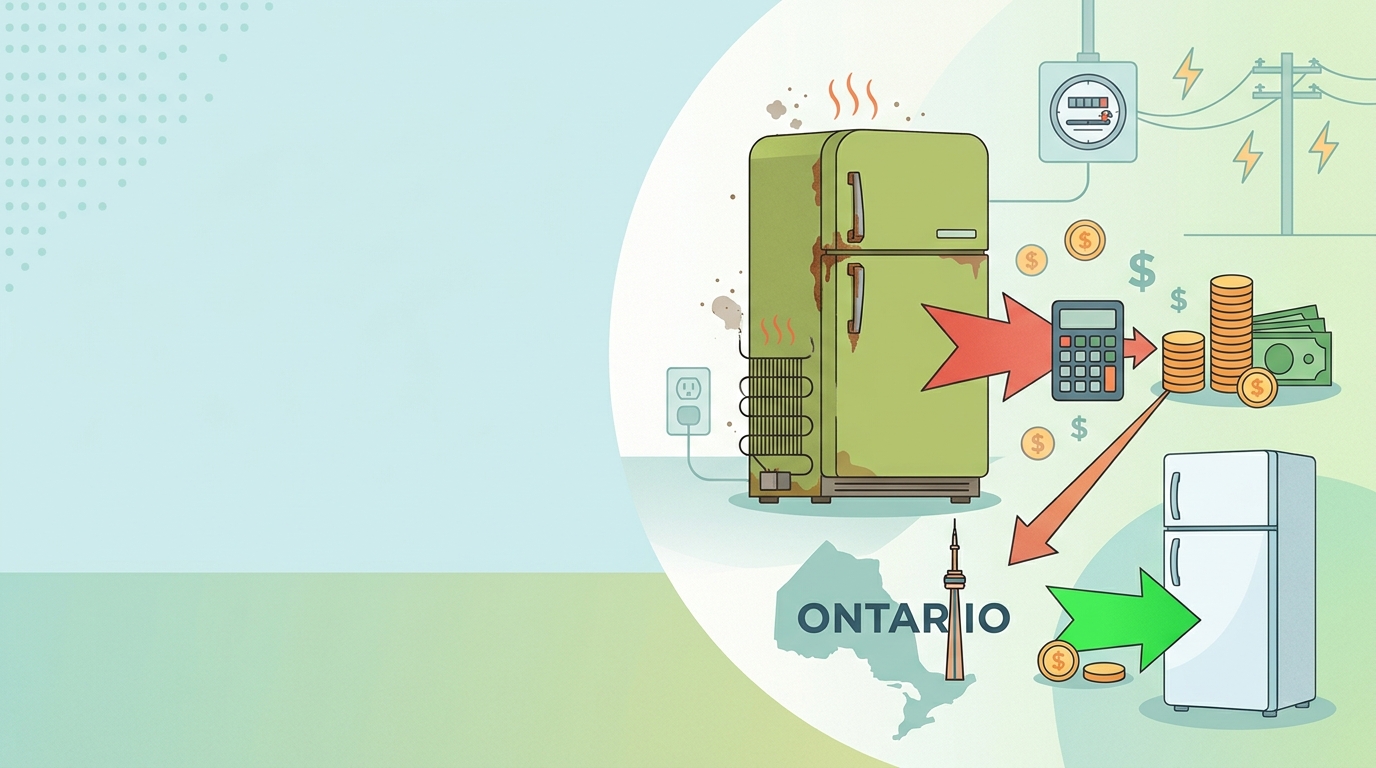
An average fridge from 1990 was rated at 956 kWh a year. On Ontario Time-of-Use, that costs about $113.09 a year for the Electricity line, or $1,130.95 over 10 years. If you rarely need the second fridge, unplugging it saves all of that. If you need it every week, replacing it only pays when the yearly saving beats the price over the years you keep the new one.
The formula is simple: kWh per year times your price per kWh. Try it with your own fridge.
What does your second fridge cost a year?
Enter the kWh per year from the fridge’s EnerGuide label (it starts at the 1990 average), a newer fridge to compare, and your price per kWh. The result updates as you type.
kWh per year x price. 11.83¢ is the average Time-of-Use price for an appliance that runs all day; use 13.36¢ for Ultra-Low Overnight or 11.2¢ for Tiered. Electricity line only, before delivery and regulatory charges, taxes and rebates. Calculator by Gizly.
How much power does an old fridge use?
A kilowatt-hour (kWh) is 1,000 watts used for one hour. It is the unit on your hydro bill. Fridges are rated in kWh per year.
Natural Resources Canada (NRCan) tracked new fridges sold in Canada. Its trends report found the average new fridge used 956 kWh a year in 1990 and 430 kWh in 2009. For the common 18.5 to 20.4 cubic foot size, use fell from 1,133 to 456 kWh a year, a 60% drop.
These are ratings for fridges when new, so your fridge’s real use can differ. NRCan’s fridge advice says an old fridge uses about 35% more energy, on average, than an ENERGY STAR certified model. It also says to clean the condenser coils regularly and keep the door seals clean and tight.
How to find your own fridge’s number
Check for the EnerGuide label. NRCan’s EnerGuide guide says it shows annual energy use in kWh, and the lower the number, the more efficient the model. If the label is gone, a plug-in energy meter between the fridge and the outlet can measure real use over a week. Multiply that by 52 for a yearly figure.
Why does your price plan change the answer?
The Ontario Energy Board (OEB) sets three price plans. Its rates page lists these prices, effective November 1, 2026:
- Time-of-Use (TOU): 9.1¢ off-peak, 14.6¢ mid-peak and 18.9¢ on-peak. Weekends and holidays are off-peak all day.
- Ultra-Low Overnight (ULO): 3.7¢ from 11 p.m. to 7 a.m. every day, 9.1¢ on weekend days, 14.6¢ mid-peak and 37.7¢ from 4 to 9 p.m. on weekdays.
- Tiered: 11.2¢ for the first 1,000 kWh a month in winter and 600 kWh in summer, and 13.2¢ above that.
A dryer or a car charger can wait for cheap hours. A fridge cannot. It pays the average of every hour in the week.
On TOU, 108 of the week’s 168 hours are off-peak, so a fridge averages 11.83¢. On ULO, the 25 weekday hours at 37.7¢ pull the average up to 13.36¢. TOU winter and summer hours differ, but each season has the same number of hours at each price, so the average holds all year.
| Plan | Avg price | 1990 fridge | 2009 fridge |
|---|---|---|---|
| TOU | 11.83¢ | $113.09 | $50.87 |
| ULO | 13.36¢ | $127.72 | $57.45 |
| Tiered, low | 11.2¢ | $107.07 | $48.16 |
| Tiered, high | 13.2¢ | $126.19 | $56.76 |
Hypothetical yearly cost of a 1990 fridge rated 956 kWh and a 2009 fridge rated 430 kWh. Electricity line only, at OEB prices effective November 1, 2026. Holidays are left out, which slightly overstates TOU and ULO.
On Tiered, a 956 kWh fridge adds about 79.7 kWh a month. If your home is near the 1,000 kWh winter threshold, part of that is billed at 13.2¢. Our space heater cost guide shows how the threshold works.
What people get wrong about second fridges
- “It is already paid for, so it is free.” The purchase is paid for. The power is not. An average 1990 fridge costs about $113 a year on TOU, every year.
- “Ultra-Low Overnight makes everything cheaper.” Only what you can move to the night. A fridge runs through the 37.7¢ hours too, so on ULO it costs about $14.63 more a year than on TOU.
- “Moving the old fridge to the garage is the green choice.” NRCan advises the opposite. When you buy a new fridge, it says to recycle the old one instead of reusing it elsewhere, even in the garage or at the cottage.
Should you unplug it, replace it or keep it?
It depends on how often you use it. Three common situations, using an average 1990 fridge on TOU:
If it mostly holds drinks and overflow
Unplug it and empty it. You save about $113.09 a year, or $1,130.95 over 10 years. If you need it for the holidays only, running it for 6 weeks costs about $13.05.
If you use it every week
A fridge rated 430 kWh would save about $62.23 a year. Over 10 years that is $622.30. If a new fridge costs more than your saving over the years you plan to keep it, the power bill alone does not justify the switch. If you do buy, check our Ontario appliance rebates guide for any rebate that applies.
If money is tight
You may qualify for a free replacement. The Save on Energy Energy Affordability Program (EAP) offers free upgrades, which can include an ENERGY STAR fridge or freezer, depending on eligibility and the equipment in your home. Its FAQ says an in-home assessment decides what gets replaced, and the old appliance is removed and disposed of.
Eligibility for this full support is based on income or other programs. For example, the income limit is $48,220 before tax for one person and $96,439 for a household of four. You can also qualify if you received help in the past 12 months from programs such as the Ontario Electricity Support Program (OESP), Ontario Works or the Ontario Disability Support Program. Renters can apply; if a landlord owns the fridge, the landlord is offered the upgrade.
Which choice fits you?
How do you get rid of an old fridge?
Rules depend on your city. In Toronto, the City’s oversized and metal items page says items set out beside your garbage bin are picked up on your collection day, with no booking. It says to remove the doors from fridges first, and the City’s abandoned appliances rule says doors and locks of fridges and freezers must be removed before they go out. Outside Toronto, check your municipality’s waste page.
Your next steps
Three checks before you spend anything.
- Find the kWh numberLook for the EnerGuide label or the model number, or measure a week of use with a plug-in meter and multiply by 52.
- Check your price planYour bill shows TOU, ULO or Tiered. Use 11.83¢, 13.36¢ or 11.2¢ in the calculator above.
- Decide, then actIf you rarely use it, unplug it. If your household may qualify, call the Energy Affordability Program at 1-844-770-3148 before buying a new one.
Other appliances add up too. See what a dryer costs per load at the same 2026 rates.
Frequently asked questions
How much does it cost to run an old fridge in Ontario?
An average fridge from 1990 was rated at 956 kWh a year when new, according to Natural Resources Canada. At the average Time-of-Use price for an appliance that runs all day, 11.83¢ per kWh, that is about $113.09 a year for the Electricity line, at prices effective November 1, 2026.
Does a fridge cost more on Ultra-Low Overnight?
Usually, yes. A fridge runs every hour, including 25 hours a week at the 37.7¢ on-peak price. Its average works out to 13.36¢ per kWh on Ultra-Low Overnight, compared with 11.83¢ on Time-of-Use, unless the rest of your home gains more from cheap overnight hours.
How do I find out how much power my fridge uses?
Look for the EnerGuide label or the model number. Natural Resources Canada says the EnerGuide label shows annual energy use in kWh, and the lower the number, the more efficient the model. A plug-in energy meter can also measure what an older fridge really uses.
Is it worth replacing an old fridge just to save power?
Only if the saving adds up. Swapping a 956 kWh fridge for a 430 kWh one saves about $62.23 a year on Time-of-Use. Multiply your own saving by the years you will keep the new fridge and compare it with the price. Unplugging a second fridge you rarely need saves more.
Can I get a free fridge in Ontario?
Some households can. The Save on Energy Energy Affordability Program offers free upgrades, which may include an ENERGY STAR fridge or freezer after an in-home assessment. Eligibility is based on household income or on programs such as OESP or Ontario Works. Call 1-844-770-3148.
How do I get rid of an old fridge in Toronto?
Toronto picks up oversized and metal items set out beside your garbage bin on your collection day. The City says to remove the doors from refrigerators first, and doors and locks must be removed before a fridge is put out for collection.
- Sources, checked November 27, 2026: Ontario Energy Board: electricity rates (TOU, ULO and Tiered prices and hours effective November 1, 2026); Ontario Energy Board: historical electricity rates; Natural Resources Canada: CAMA trends report 1990 to 2009, refrigerators; Natural Resources Canada: ENERGY STAR refrigerators (modified March 19, 2025); Natural Resources Canada: EnerGuide for appliances (modified January 10, 2025); Save on Energy: Energy Affordability Program; Save on Energy: Energy Affordability Program FAQs; City of Toronto: oversized and metal items (modified September 17, 2026); City of Toronto: abandoned appliances (modified July 16, 2026).
- Method: Yearly cost = rated kWh per year x average price. Average price = each OEB price weighted by its hours in a 168-hour week, calculated by script and re-checked with a separate hour-by-hour simulation. Holidays are left out. All examples are hypothetical, use NRCan average ratings for new fridges, and exclude delivery and regulatory charges, taxes and rebates.
Important: This guide is general information, not financial advice. Electricity prices and program rules can change; check your own bill, your utility and Save on Energy before you decide. Gizly is not paid by any utility, program or retailer, and this page has no affiliate links. See our affiliate disclosure.
Send it to a friend, a family member or a coworker with the same question. It takes one tap.
How this page was made: Gizly uses AI tools to help research and draft its guides. Krish Paul, the editor, is responsible for what Gizly publishes. Spot an error? Tell us and we will fix it.
Keep reading


Compare before you switch
Rates and offers checked against each bank’s own page.