How Much Do Christmas Lights Cost to Run in Ontario? 2026 Rates
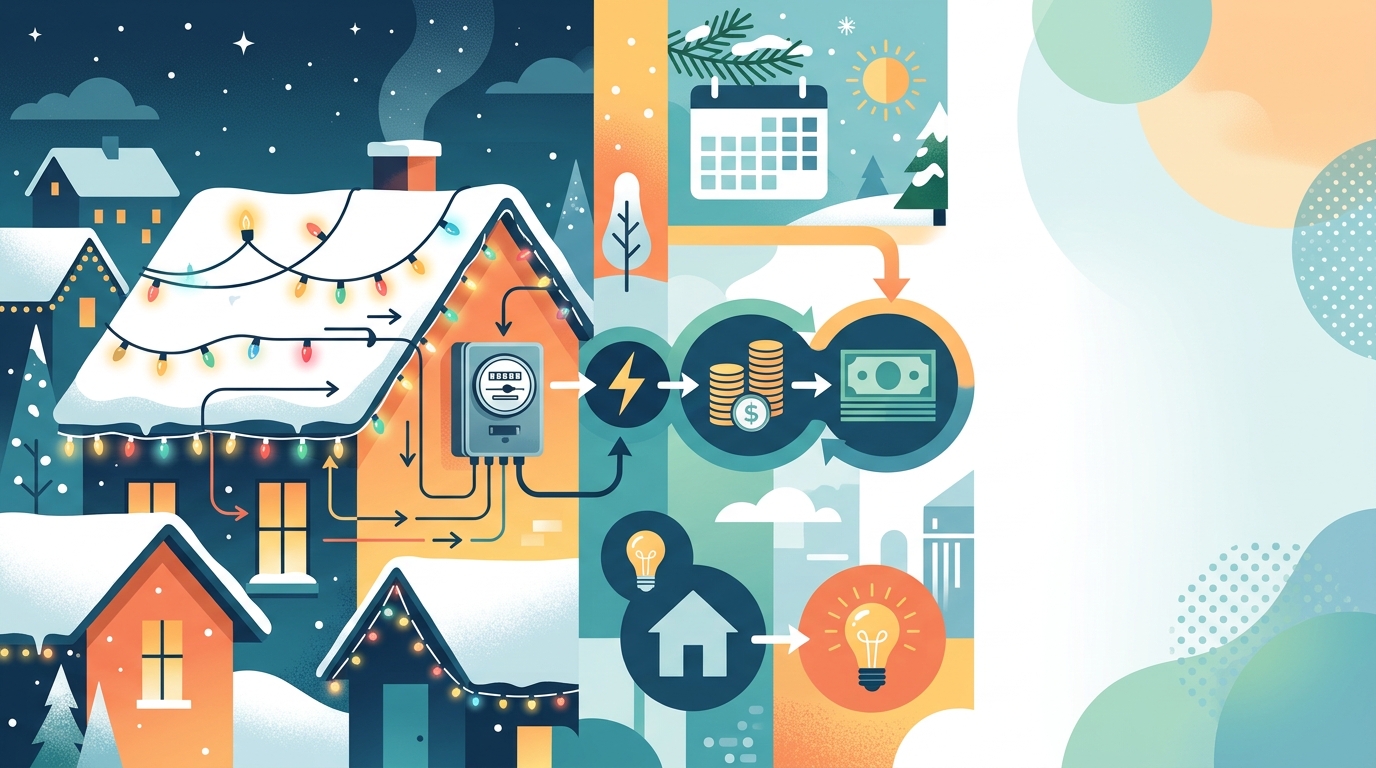
A string of 100 old-style incandescent mini lights draws about 40.8 watts, and an LED string about 4.8. What that costs in Ontario depends on your price plan and the hours your lights are on.
- Rates checked November 19, 2026
- By Krish Paul
- 6 min read
On this page
We priced a typical display on every Ontario plan at the rates that took effect on November 1, 2026, and worked out when switching to LED pays off.
The short answer
A display of 8 incandescent strings of 100 mini lights, on from 5 to 11 p.m. for six weeks, costs about $9.40 in electricity on Ontario Time-of-Use and $19.76 on Ultra-Low Overnight at prices effective November 1, 2026. The same display in LED costs about $1.11 and $2.33.
For most homes with LED lights, the bill impact is a dollar or two. With older incandescent strings on Ultra-Low Overnight, the evening hours make a big difference. Try your own numbers below.
Work out what your lights cost this season
Enter your number of strings, the watts on each string’s label and your price per kWh. The result updates as you type.
Assumes 6 hours a day for 42 days. 9.1¢ is the Time-of-Use off-peak price. For lights on from 5 to 11 p.m., use about 11.4¢ on Time-of-Use or 24.0¢ on Ultra-Low Overnight. Covers the Electricity line only. Calculator by Gizly.
How much power a string of lights uses
The Canada Energy Regulator compared strings of 100 lights and found an incandescent string draws 40.8 watts and an LED string 4.8 watts. That makes the LED string about 88% lower in power for the same number of bulbs.
Watts become energy over time. At 6 hours a day for a 42-day season, one incandescent string uses 40.8 x 6 x 42, or about 10.3 kWh. One LED string uses about 1.2 kWh, so the incandescent string uses about 8.5 times the electricity.
Bigger bulbs use far more. A 2018 BC Hydro report says three strands holding 75 incandescent C9 bulbs draw 525 watts, while the LED version draws 6 watts. If you have the large old-style bulbs, read the watts on the box or tag and enter them in the calculator.
What a season costs on each Ontario plan
The Ontario Energy Board sets Time-of-Use (TOU), Ultra-Low Overnight (ULO) and Tiered prices once a year for households that buy electricity from their utility rather than through a retailer contract. Its electricity rates page lists the prices that took effect on November 1, 2026. We applied them to a hypothetical display: 8 strings of 100 mini lights, on from 5 to 11 p.m. every day for six weeks, or 30 weekdays and 12 weekend days.
| Ontario price plan | Incandescent | LED | LED saves |
|---|---|---|---|
| Time-of-Use (TOU) | $9.40 | $1.11 | $8.30 |
| Ultra-Low Overnight (ULO) | $19.76 | $2.33 | $17.44 |
| Tiered, under the monthly threshold | $9.21 | $1.08 | $8.13 |
| Tiered, over the monthly threshold | $10.86 | $1.28 | $9.58 |
Cost = watts x hours x price per kWh, for each hour at the price in effect. Statutory holidays are treated as weekdays, so the real cost is slightly lower. Electricity line only.
On TOU and Tiered, the result lands between $9 and $11 with incandescent strings. On ULO, the same lights cost about twice as much, because most of the evening falls in its highest price period.
Why ULO evenings cost more
Holiday lights run in the evening, which is when ULO charges the most. On winter weekdays, ULO charges 37.7¢ per kWh from 4 to 9 p.m. TOU charges 18.9¢ from 5 to 7 p.m. and drops to its 9.1¢ off-peak price at 7 p.m.
On a single weekday evening, 8 incandescent strings cost about 24¢ on TOU and 59¢ on ULO. The LED versions cost about 3¢ and 7¢. On weekends, both plans charge 9.1¢ during these hours.
That does not mean ULO is a bad plan for you. It rewards running big loads overnight, at 3.7¢. Our TOU vs ULO vs Tiered comparison shows how to check your whole bill before switching.
Does switching to LED pay off?
Look at the saving per string. With lights on from 5 to 11 p.m. for six weeks, replacing one 100-bulb incandescent string with LED saves about:
- TOU: $1.04 a season.
- Tiered: $1.02 a season under the threshold, or $1.20 over it.
- ULO: $2.18 a season.
To find your payback, divide the price of a new LED string by that saving. On TOU, each dollar of LED price takes about one season to earn back in electricity. On ULO, it takes about half a season. Bigger C9 bulbs, longer hours and more strings all shorten the wait.
Electricity is not the only factor. Incandescent strings that still work cost nothing to keep, and many older strings will be retired for other reasons first. If your strings are failing anyway, LED is the cheaper choice to run.
Leaving lights on overnight
Some people leave lights on all night. Adding 8 more hours, from 11 p.m. to 7 a.m., to the 8 incandescent strings for 42 nights adds about $9.98 on TOU at 9.1¢ and $4.06 on ULO at 3.7¢. With LED strings, it adds about $0.48 on ULO. A plug-in timer makes this a non-issue.
The same math works for other things you plug in this winter. Our guides to what a space heater costs to run and what a dryer load costs in Ontario use the same November 2026 prices.
What these numbers leave out
Every figure here covers the Electricity line of your bill. The OEB bill guide lists separate Delivery and Regulatory charges, and the provincial Ontario Electricity Rebate provides some bill relief. The watts come from one government comparison of 100-bulb strings. Your lights may draw more or less, so the label on the string is the best guide.
How to keep your lights cheap
A few small habits do most of the work.
- Read the labelWatts per string tell you more than bulb count.
- Use a timerLights left on all night add cost and wear for no one to see.
- Watch ULO weekday eveningsFrom 4 to 9 p.m., ULO is 37.7¢ per kWh, so LED strings matter most there.
- Replace the biggest bulbs firstOld C9 strings draw the most power per string.
- Check your plan on your billIt shows whether you pay TOU, ULO or Tiered prices.
Frequently asked questions
How much does it cost to run Christmas lights in Ontario?
A string of 100 incandescent mini lights draws about 40.8 watts and a string of 100 LED mini lights about 4.8 watts. Eight incandescent strings on from 5 to 11 p.m. for six weeks cost about $9.40 on Time-of-Use and $19.76 on Ultra-Low Overnight at prices effective November 1, 2026. The same display in LED costs $1.11 and $2.33, for the Electricity line only.
How much power does a string of Christmas lights use?
The Canada Energy Regulator puts a string of 100 incandescent lights at 40.8 watts and a string of 100 LED lights at 4.8 watts. Bigger bulbs use more. BC Hydro says three strands with 75 incandescent C9 bulbs draw 525 watts, against 6 watts for LEDs. Check the label on your own lights.
What is the cheapest time to run Christmas lights in Ontario?
On Time-of-Use, weekday evenings are off-peak at 9.1¢ per kWh from 7 p.m., and weekends are 9.1¢ all day. On Ultra-Low Overnight, weekdays from 4 to 9 p.m. cost 37.7¢, the highest price on any plan, so a timer that starts at 9 p.m. or LED lights cut the most.
Is it expensive to leave Christmas lights on all night?
Leaving 8 incandescent strings on for 8 more hours a night, from 11 p.m. to 7 a.m., adds about $9.98 over six weeks on Time-of-Use and $4.06 on Ultra-Low Overnight. With LED strings it adds about $0.48 on Ultra-Low Overnight. A timer avoids the cost and the wear.
Are LED Christmas lights worth switching to?
For the electricity alone, replacing one 100-bulb incandescent string with LED saves about $1.04 a season on Time-of-Use and $2.18 on Ultra-Low Overnight with lights on from 5 to 11 p.m. for six weeks. If you use your lights longer, have more strings or use bigger bulbs, the saving grows.
- Sources, checked November 19, 2026: Ontario Energy Board: electricity rates (TOU, ULO and Tiered prices effective November 1, 2026); Ontario Energy Board: understanding your electricity bill; Canada Energy Regulator: Market Snapshot, LED Christmas lights are cost and energy saving compared to incandescent (December 22, 2015); BC Hydro: From Grinch to Griswold report (November 2018).
- Method: Energy = strings x watts per string x hours. Display example: 8 strings of 100 mini lights at 40.8 watts (incandescent) or 4.8 watts (LED), on from 5 to 11 p.m. for 42 days (30 weekdays, 12 weekend days), with each hour priced at the OEB price in effect. Holidays treated as weekdays. Calculated by script and re-checked by a second method that multiplies total kWh by the average price for the evening. All examples are hypothetical and exclude delivery, regulatory charges, taxes and rebates.
Important: This guide is general information, not financial advice. Electricity prices and plan rules can change; check your own bill and your utility before you change plans. Gizly is not paid by any utility or lighting maker, and this page has no affiliate links. See our affiliate disclosure.
Send it to a friend, a family member or a coworker with the same question. It takes one tap.
How this page was made: Gizly uses AI tools to help research and draft its guides. Krish Paul, the editor, is responsible for what Gizly publishes. Spot an error? Tell us and we will fix it.
Keep reading

Compare before you switch
Rates and offers checked against each bank’s own page.