Can a Bank Close Your Account Without Notice in Canada? The 30-Day Norm
A letter says your bank is closing your account in 30 days, and it does not say why. That is legal in Canada, and you have more options than it feels like.
- Rules checked November 12, 2026
- By Krish Paul
- 8 min read
On this page
- The short answer
- Closing an account vs refusing to open one
- What your account agreement allows
- What OBSI can and cannot do
- A worked example: 30 days to move your banking
- Before the closing date, get these in writing
- What to do if your bank closes your account
- If another bank refuses to open your account
- Frequently asked questions
This guide covers what the law says, what bank agreements allow, what the banking ombudsman can and cannot do, and a day-by-day plan for moving your money.
The short answer
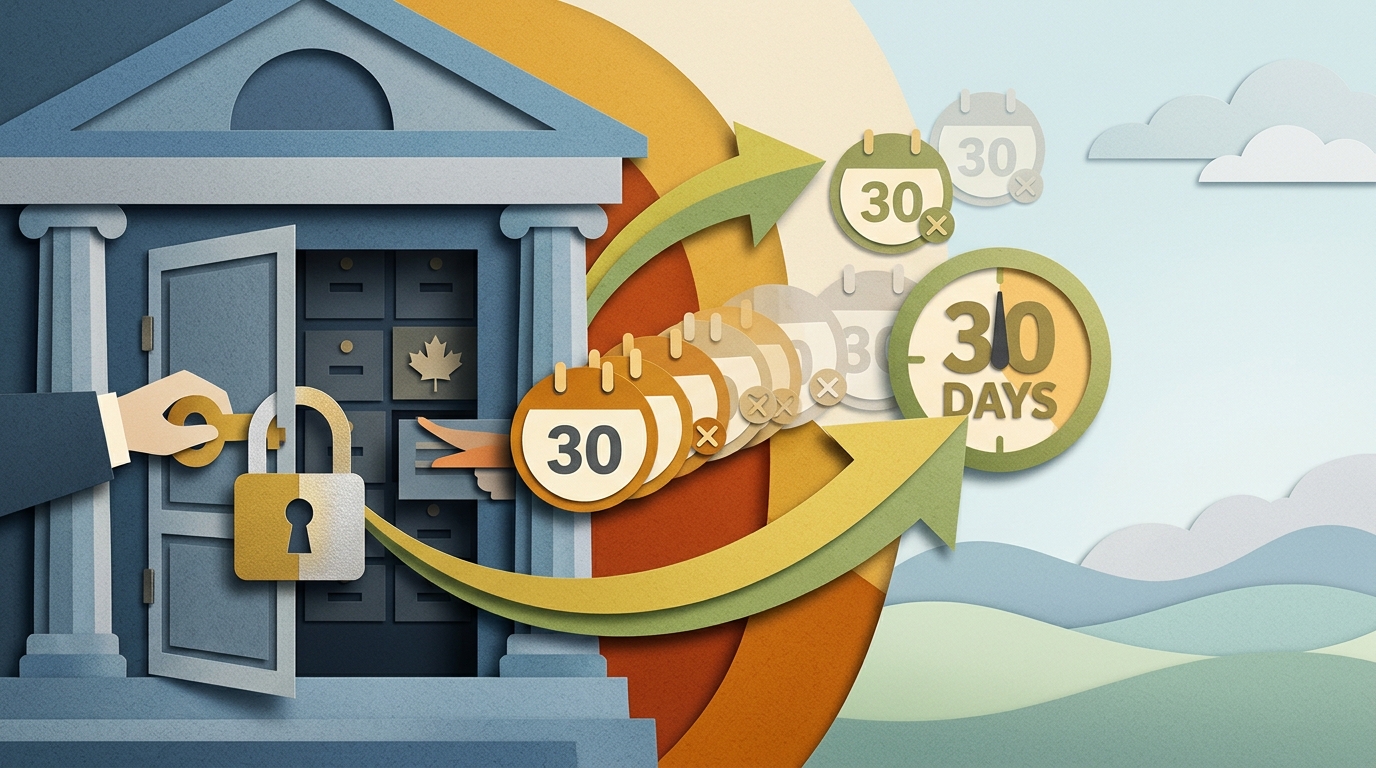
Yes, a Canadian bank can close your account, and it does not have to give you a reason. No federal rule sets a notice period, so your account agreement decides. In practice, banks usually give about 30 days of written notice, and closing without any notice is rare.
That is how the Ombudsman for Banking Services and Investments (OBSI) describes it. OBSI handles complaints that banks do not resolve, and it says most account agreements let the bank close an account without giving a reason. The notice usually comes in writing to the email or mailing address the bank has on file.
The law treats closing an account very differently from refusing to open one. A bank has wide room to end a relationship. Another bank has much less room to turn you away when you try to open a new basic account.
Closing an account vs refusing to open one
| Question | Bank closes your account | Bank refuses a new basic account |
|---|---|---|
| Must the bank give a reason? | No | Must give a written statement that it will not open it |
| How much notice? | Set by your agreement, typically 30 days | Not applicable |
| Are the grounds limited by law? | No. Most agreements allow closure for any reason | Yes. Bank Act section 627.18 lists them |
| Is bankruptcy alone a valid ground? | Not addressed by the law | No |
| Minimum deposit or balance | Not applicable | None can be required ($0) |
Sources: OBSI, Relationship ended; Bank Act sections 627.17 and 627.18 and section 627.19. The access rules apply to member banks under the Bank Act and to individuals opening personal deposit accounts.
What your account agreement allows
The real rules are in the agreement you accepted when you opened the account. CIBC's Personal Account Agreement (form 8249-2024/11) is a typical example. In section 15 it says the bank may "suspend, freeze, block or terminate your right to use your account, without notice even if you are not in default" of the agreement.
The reasons it lists include:
- You were the victim of fraud or identity theft, and the bank wants to prevent future losses.
- The law requires it.
- There is a dispute or uncertainty over who is entitled to the money in the account.
- The bank has reasonable grounds to believe you did or may commit fraud, use the account unlawfully or cause it a loss.
- You run the account in an unsatisfactory way or against the bank's policies, or you break the agreement.
- The bank chooses to.
That last reason is the important one. It means the list is not a limit. The same agreement also lets CIBC close dormant accounts that have a nil balance, and close your account when an overdraft becomes a demand loan.
Frozen is not the same as closed
A freeze or block stops you from using the account for a while. It often follows a fraud alert, a disputed deposit or a legal order. A closure ends the relationship. If your card suddenly stops working, ask the bank which one it is before you assume the worst.
What OBSI can and cannot do
If you think the closure was unfair, you can complain to the bank and then to its external complaints body. For many banks that is OBSI. Be realistic about the outcome. OBSI says plainly: "We are not able to challenge or change a bank's decision."
What OBSI can review is how the closure was done. It looks at whether you got reasonable notice, whether a special situation called for more notice or flexibility, and whether the closure was biased, against the bank's own policies or unfair given your situation. If the bank gave the notice in your agreement or reasonable notice, OBSI generally does not recommend compensation. In rare cases it may recommend a refund of fees or compensation when notice was too short.
OBSI also says some closures can reasonably take longer than 30 days. Its examples are registered accounts, business accounts, loans and non-redeemable GICs, which cannot simply be emptied in a month.
In one OBSI case from 2022, a customer asked for 60 days instead of the 30 days of written notice he received. OBSI found the bank had acted within its agreement and recommended no compensation.
For how long a bank has to answer a complaint before you can escalate, see our guide on how long a bank has to respond to a complaint.
A worked example: 30 days to move your banking
Say a closure letter dated Thursday, November 12, 2026, gives you 30 days. Counting calendar days, the account closes on Saturday, December 12, 2026. Here is one way to use that time.
Hypothetical example. Dates were counted by script from the letter date. Your letter sets your actual closing date, so use that.
The order matters. Deposits come first, because a paycheque or benefit payment sent to a closed account can be returned and delayed. Pre-authorized debits come next, because a missed bill can trigger late fees with the company you owe. Cheques come near the end. CIBC's agreement says you stay liable for cheques drawn on or deposited to the account that have not cleared, even after it closes.
Before the closing date, get these in writing
A few records save a lot of trouble later, especially if a payment goes astray.
- The closure letterKeep it, with the date you received it and the closing date it gives.
- Your final statementsDownload at least the last 12 months. You may lose online access once the account closes.
- Proof of the final transferSave the confirmation for the money you moved out.
What to do if your bank closes your account
- Read the letter for the closing date. Ask which accounts and products it covers: chequing, savings, credit cards, registered plans and loans can be handled differently.
- Ask if it is a freeze or a closure. A freeze is meant to be temporary, so ask what the bank needs from you to lift it.
- Open a new account right away. A bank must open a basic account for you if you meet the ID conditions, unless it has a legal ground to refuse. It cannot ask for a minimum deposit.
- Switch deposits, then payments. Update your employer, government payments and any e-Transfer autodeposit, then each pre-authorized debit and bill payment.
- Ask for more time if you need it. Registered plans, loans and locked-in GICs can take longer. Ask in writing and keep the reply.
- Complain if notice was too short. Go to the bank's complaints office first, then to OBSI or the bank's external complaints body.
If you are worried about fees at a new bank, see who qualifies for a free bank account. If an old company keeps pulling from the closed account, our guide to reversing a pre-authorized debit explains the claim process.
If another bank refuses to open your account
Under section 627.17 of the Bank Act, a member bank must open a retail deposit account for a person who asks in person and meets the conditions, such as showing acceptable ID. It cannot require an initial deposit or a minimum balance.
Section 627.18 lists when the bank can say no. The main grounds are reasonable grounds to believe the account will be used for illegal or fraudulent purposes, a history of illegal or fraudulent activity with financial service providers in the last seven years, a knowing material misrepresentation, or a need to protect customers or staff from harm or harassment.
Being or having been bankrupt is not enough on its own. If the bank refuses, section 627.19 says it must give you a written statement that it will not open the account.
Frequently asked questions
Can a bank close my account without telling me?
It can, if your account agreement allows it, and most do. There is no federal rule that sets a notice period for a bank closing a personal account. The banking ombudsman, OBSI, says banks usually give reasonable notice, typically 30 days, and only close accounts without notice in rare situations.
Does a bank have to tell me why it closed my account?
No. OBSI says banks are not required to explain the reason for an account closure and generally do not. Most account agreements say the bank can close the account without giving a reason.
What happens to the money in a closed account?
During the notice period you move it yourself. OBSI says that in rare cases where a bank closes accounts without notice, it sends the consumer their money. At CIBC, for example, you stay liable for cheques that have not cleared, even after the account closes.
Can I complain if my bank closes my account?
Yes. Complain to the bank first, then to its external complaints body, such as OBSI. OBSI cannot challenge or change a bank’s decision to close an account, but it can look at whether you got reasonable notice and whether the closure was handled fairly.
Can another bank refuse to open an account for me?
Only for reasons the Bank Act allows. A bank must open a basic deposit account for a person who meets the ID and other conditions, unless it has grounds such as suspected fraud or illegal use. It cannot require a minimum deposit, and if it refuses it must give you a written statement saying it will not open the account.
Is a frozen account the same as a closed account?
No. A freeze or block stops you from using the account for a time, while a closure ends it. CIBC’s agreement, for example, lets the bank suspend, freeze, block or terminate your use of the account without notice, for reasons that range from suspected fraud to a dispute over who owns the funds.
- Sources, checked November 12, 2026: OBSI: Relationship ended; OBSI: Consumer surprised when bank gives him 30 days to close his account (published November 3, 2022); CIBC Personal Account Agreement, form 8249-2024/11, sections 10, 14, 15 and 23; Bank Act, sections 627.17 and 627.18 (current to 2026-09-30); Bank Act, section 627.19 (current to 2026-10-19).
- Method: The example dates were counted by script from November 12, 2026, and checked a second way with a weekday lookup. Notice periods vary by agreement, so your letter governs.
Important: This guide is general information, not legal or financial advice. Account agreements differ by bank and change over time, so read your own. Credit unions and caisses populaires follow provincial rules. Gizly is not paid by any bank mentioned here. See our affiliate disclosure.
Send it to a friend, a family member or a coworker with the same question. It takes one tap.
How this page was made: Gizly uses AI tools to help research and draft its guides. Krish Paul, the editor, is responsible for what Gizly publishes. Spot an error? Tell us and we will fix it.
Keep reading


Compare before you switch
Rates and offers checked against each bank’s own page.