Bill S-8: Ottawa Moves to Limit $10,000 Cash Payments and Ban Unlicensed Crypto ATMs
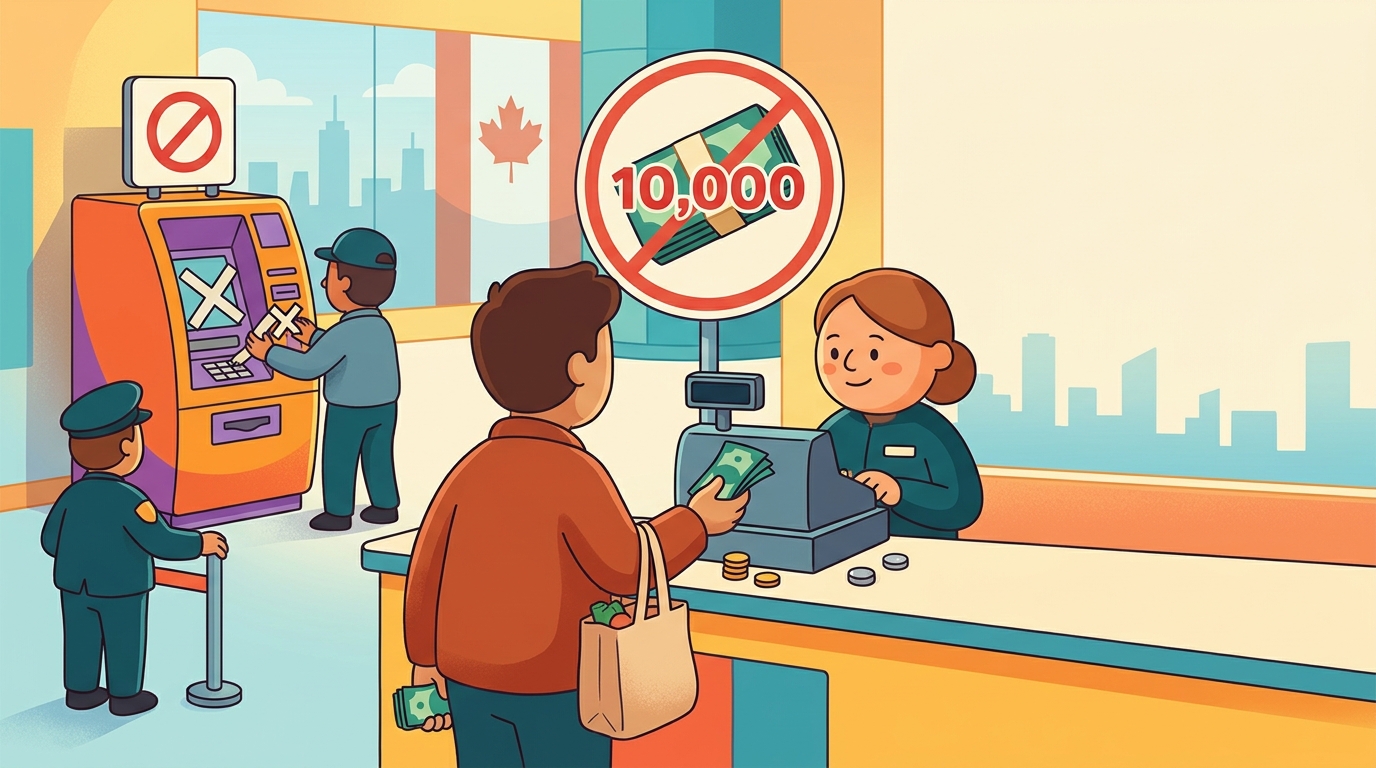
Ottawa wants to restrict cash payments of $10,000 or more, shut down crypto ATMs that lack a provincial licence and let police search mail. The bill was tabled on November 3 and is not law yet.
- Checked against Finance Canada and Parliament, November 4, 2026
- By Krish Paul
- 10 min read
On this page
- What Bill S-8 would change
- The $10,000 cash limit
- Crypto ATMs: licensed machines stay, unlicensed ones must close
- If someone sends you to a crypto ATM, it is a scam
- Money services businesses face tougher checks
- Police could search mail, as they already can with couriers
- Banks could act on tips from police
- What the ministers said
- Part of a wider financial crime plan
- What happens next
- What it means for you
- Frequently asked questions
The federal government introduced Bill S-8, the Combatting Financial Crimes and Drug Trafficking Act, in the Senate on Tuesday, November 3, 2026. The Department of Finance announced it the same day, with statements from Finance Minister François-Philippe Champagne and Public Safety Minister Gary Anandasangaree.
The bill bundles five measures aimed at fraud, money laundering and drug trafficking. Two of them reach everyday Canadians directly: a limit on large cash payments and new rules for crypto ATMs. As of November 4, Parliament’s bill tracker lists Bill S-8 at second reading in the Senate.
What Bill S-8 would change
| Measure | What the bill proposes | Who notices |
|---|---|---|
| Large cash payments | Restricts cash transactions of $10,000 or more, and cash deposits into another person’s account | Anyone who pays for big items in cash |
| Crypto ATMs | Makes it a crime to run a crypto ATM that is not licensed by a province or territory | Crypto ATM users and operators |
| Money services businesses | Tighter registration, wider criminal record checks and new powers for ministers and FINTRAC | People who send money abroad or exchange currency |
| Lets police search and seize mail when they have lawful authority under three federal laws | Anyone who sends or receives mail | |
| Information sharing | Lets banks and other regulated businesses use information police share with them to fight money laundering | Bank customers, mostly behind the scenes |
Gizly summary of the Department of Finance Canada backgrounder published November 3, 2026.
Nothing changes today. Bill S-8 is a proposal. It has to pass the Senate and the House of Commons and receive Royal Assent before any of these rules apply, and parts of it can change along the way.
The $10,000 cash limit
Bill S-8 would restrict cash transactions of $10,000 or more. The government says Canada and Japan are the only G7 countries without a framework that restricts or regulates large cash payments across the economy.
Banks, credit unions and other deposit-taking institutions are exempt from the large cash restriction, so putting your own cash into your bank account is not the target. For big purchases, Finance Canada points to cheques, debit, credit cards, wire transfers and e-Transfers.
This would sit on top of a rule that already exists. Today, banks and other reporting businesses must send FINTRAC a Large Cash Transaction Report when they receive $10,000 or more in cash, in one payment or in several payments within 24 hours. That report does not stop the payment. Bill S-8 would restrict the payment itself. Our guide to cash deposits over $10,000 explains how the reporting rule works at your bank.
Large cash payments are rare. Cash made up 1% of the value of payments in Canada in 2025, and the average cash payment was $24, according to the backgrounder.
Cash deposits into someone else’s account
The bill would also restrict third-party cash deposits, where one person puts cash into another person’s account. Money mules use this to spread criminal cash across many accounts. The backgrounder names the bank exemption only for the large cash restriction, not for third-party deposits.
Finance Canada’s release and backgrounder do not say when the cash rules would start, what the penalties would be or how cash deposits for family members would be treated. We will update this story when those details are published.
Planning a big cash purchase? If you expect to pay for a car, a renovation or another large bill in cash, ask the seller about a bank draft, wire or e-Transfer instead. Once the rule is in force, a cash payment of $10,000 or more may not be allowed.
Crypto ATMs: licensed machines stay, unlicensed ones must close
Bill S-8 would make it a criminal offence to operate a crypto ATM that is not licensed as a money services business by a province or territory. Machines that stay in service would face new federal rules, which Finance Canada says would match the highest regulatory standards now used internationally.
| Crypto ATM measure | Takes effect |
|---|---|
| New federal rules for crypto ATMs that are allowed to keep operating | 90 to 180 days after Royal Assent |
| Running a crypto ATM without a provincial or territorial licence becomes a criminal offence | 18 months after Royal Assent |
The 18-month delay gives provinces and territories without a licensing system time to set one up. Quebec already has one: Revenu Québec requires a licence to operate a cryptoasset ATM under the province’s Money-Services Businesses Act.
This is narrower than the plan in the April 28, 2026 Spring Economic Update, which proposed banning crypto ATMs outright. Under Bill S-8, a machine can keep running if its province licenses it. Regulated online and in-person crypto platforms also stay open.
Why Ottawa is targeting the machines
The backgrounder cites studies that link 85% to 98% of crypto ATM transactions to illicit activity. The Canadian Anti-Fraud Centre estimates Canadians lost between $142 million and $284 million to crypto ATM fraud in 2024. That range assumes only 5% to 10% of fraud is ever reported.
Those percentages come from narrow samples. When Ottawa first floated a ban in April, BetaKit reported that the 85% figure came from an Australian review of 90 heavy crypto ATM users and the 98% figure from two large operators in Iowa. Canada has close to 4,000 crypto ATMs, according to Coin ATM Radar figures reported by Decrypt. Operators pushed back on the April plan and asked Ottawa to consult the industry first, arguing that the machines have legitimate uses.
If someone sends you to a crypto ATM, it is a scam
Scammers often pose as the CRA, the police or your bank and tell you to pay at a crypto ATM. Once the cash is converted and sent, it is very hard to get back.
- No real agency asks for cryptoThe RCMP says government departments and police never demand payment through cryptocurrency, Bitcoin ATMs, gift cards or prepaid credit cards.
- Hang up and call backUse the phone number on the agency’s or bank’s official website, not one the caller gives you.
- Report itCall the Canadian Anti-Fraud Centre at 1-888-495-8501, even if you did not lose money.
Money services businesses face tougher checks
Money services businesses include currency exchanges, money transfer and remittance companies, and crypto dealers. Canada’s 2025 National Risk Assessment rates them as highly vulnerable to money laundering and terrorist financing. Bill S-8 would:
- Let the Minister of Finance direct FINTRAC to deny or revoke a registration to protect national security or the integrity of the financial system.
- Let ministers temporarily suspend registrations for all such businesses or for one class of them, require extra due diligence and temporarily limit or ban some domestic transactions. Similar powers already apply to transactions to and from other countries.
- Widen FINTRAC’s power to refuse or revoke registrations, so criminal and non-compliant businesses cannot simply register again.
- Lower the ownership stake that triggers criminal record checks on owners and investors from 20% to 5%.
- Require more current information on when a business starts operating, its finances and the services it offers.
- Make a business ineligible if its payment service provider registration under the Retail Payment Activities Act is refused or revoked for national security reasons.
The government says Canadians would keep access to the full range of money services. Before you send money abroad, search the company in FINTRAC’s Money Services Business Registry and check that its status shows as registered.
Police could search mail, as they already can with couriers
Today, police are limited in their ability to search and seize mail moving through Canada Post, even when they have enough evidence to get a warrant, according to the backgrounder. Bill S-8 would amend the Canada Post Corporation Act so police can search and seize mail when they have lawful authority under the Criminal Code, the Controlled Drugs and Substances Act or the Cannabis Act. Private couriers already work under that standard.
The government says criminals use the mail to ship fentanyl, counterfeit money, stolen goods and child sexual abuse material. Under the Cannabis Act, the power would cover suspected illegal distribution, including organized crime working outside the legal supply chain.
Postal inspectors keep the powers they have now, which let them inspect parcels for items that cannot be mailed. Unlike Bill C-2, the Strong Borders Act tabled in June 2025, Bill S-8 would not let postal inspectors open letters.
Banks could act on tips from police
The fifth measure lets banks and other regulated businesses receive and use information that police share with them for anti-money laundering work. It comes with related changes to PIPEDA, the federal private-sector privacy law. The aim is to support the Integrated Money Laundering Intelligence Partnership, which Canada launched in February 2025 to connect police with the big banks.
What the ministers said
“This bill will make it harder for criminal networks to operate and will better protect Canadians.”
François-Philippe Champagne, Minister of Finance and National Revenue
“Bill S-8 will provide law enforcement with important new tools to combat these threats, disrupt organized crime and better protect Canadians from fraud and exploitation.”
Gary Anandasangaree, Minister of Public Safety
Part of a wider financial crime plan
Bill S-8 adds to measures from Budget 2025 and the Spring Economic Update 2026. The biggest is the Financial Crimes Agency, which Bill C-29 would set up as Canada’s lead enforcement agency for financial crime. The government tabled Bill C-29 on April 27, 2026. It is also developing a standalone National Anti-Fraud Strategy.
| Who gets it | Amount | Where it comes from |
|---|---|---|
| Financial Crimes Agency | $352.7 million over five years from 2026-27, then $82.1 million a year, plus $57.8 million in remaining amortization | Spring Economic Update 2026 (proposed) |
| Public Prosecution Service of Canada | $46.2 million over five years, then $11.5 million a year | Spring Economic Update 2026 (proposed) |
| Department of Finance Canada | $19.6 million over five years, then $1.5 million a year | Spring Economic Update 2026 (proposed) |
| RCMP | $1.7 billion over four years | Budget 2025 |
| All federal anti-financial crime investments since 2019 | Close to $379 million | Finance Canada |
Amounts as listed in the Finance Canada news release of November 3, 2026.
What happens next
- Senate second reading. Senators debate the principle of the bill. This is where it stands as of November 4, 2026.
- Senate committee and third reading. A committee studies the bill clause by clause and can propose amendments. Then the full Senate votes.
- House of Commons. MPs go through the same readings and a committee study.
- Royal Assent. The bill becomes law.
- Rules start in stages. New crypto ATM rules 90 to 180 days after Royal Assent, and the unlicensed crypto ATM ban after 18 months. The release and backgrounder give no start dates for the other measures.
What it means for you
- Nothing changes yet. You can pay, deposit and mail the way you do today.
- If you pay big bills in cash: plan to use a bank draft, wire, debit or e-Transfer for anything of $10,000 or more once the rule takes effect.
- If you use crypto ATMs: licensed machines can keep running where a province or territory licenses them, and regulated crypto platforms stay open.
- If you send money abroad: check your money transfer company in FINTRAC’s registry.
- Everyone: treat any request to pay through a crypto ATM as a scam.
Frequently asked questions
What is Bill S-8?
Bill S-8 is the Combatting Financial Crimes and Drug Trafficking Act, introduced in the Senate on November 3, 2026. It would restrict cash payments of $10,000 or more, ban crypto ATMs that lack a provincial or territorial licence, tighten rules for money services businesses, let police search mail with lawful authority and widen information sharing between police and banks.
Is Canada banning cash payments of $10,000 or more?
Not yet. Bill S-8 would restrict cash transactions of $10,000 or more, but it is still before Parliament and no start date has been announced. Banks and credit unions are exempt from the large cash restriction, so putting cash into your own bank account is not the target.
Is the new cash limit the same as the FINTRAC $10,000 reporting rule?
No. Today, banks and other reporting businesses report cash receipts of $10,000 or more to FINTRAC, and the payment still goes through. Bill S-8 would restrict the cash payment itself.
Are crypto ATMs being banned in Canada?
Bill S-8 would make it a criminal offence to run a crypto ATM that is not licensed as a money services business by a province or territory. That ban would start 18 months after Royal Assent. Licensed machines and regulated online and in-person crypto platforms could keep operating.
Can police open my mail under Bill S-8?
Police could search and seize mail if they have lawful authority under the Criminal Code, the Controlled Drugs and Substances Act or the Cannabis Act, the same standard that applies to private couriers. Postal inspectors would keep their current powers and could not open letters.
When does Bill S-8 take effect?
Only after it passes the Senate and the House of Commons and receives Royal Assent. New crypto ATM rules would follow 90 to 180 days later and the unlicensed crypto ATM ban 18 months later. As of November 4, 2026, the bill is at second reading in the Senate.
- Sources, checked November 4, 2026: Department of Finance Canada: news release on Bill S-8 (November 3, 2026); Department of Finance Canada: Bill S-8 backgrounder (November 3, 2026); Parliament of Canada LEGISinfo: Bill S-8, 45th Parliament, 1st session; LEGISinfo: Bill C-2, Strong Borders Act; FINTRAC: Reporting large cash transactions; FINTRAC: Money Services Business Registry; Revenu Québec: Cryptoasset services; RCMP Alberta: Bitcoin ATM fraud warning (September 3, 2026); BetaKit: Canada’s plan to ban crypto ATMs worries industry, advocates; Decrypt: Canadian government pushes for sweeping ban on crypto ATMs; Money.ca: Canada’s crypto ATM ban and scam victims.
- Method: We compared the news release with the backgrounder and Parliament’s bill record. Dollar figures and percentages are quoted as Finance Canada published them, and Gizly has not added estimates. We will update this story as the bill moves through Parliament.
Important: This story is general information, not legal or financial advice. Bill S-8 is a proposal and can change before it becomes law. Gizly is not paid by any company mentioned here. See our affiliate disclosure.
Keep reading



Compare before you switch
Rates and offers checked against each bank’s own page.
Send it to a friend, a family member or a coworker with the same question. It takes one tap.
How this page was made: Gizly uses AI tools to help research and draft its guides. Krish Paul, the editor, is responsible for what Gizly publishes. Spot an error? Tell us and we will fix it.